NanoClaw: Why Is a 500-Line AI Agent Framework Getting Attention?
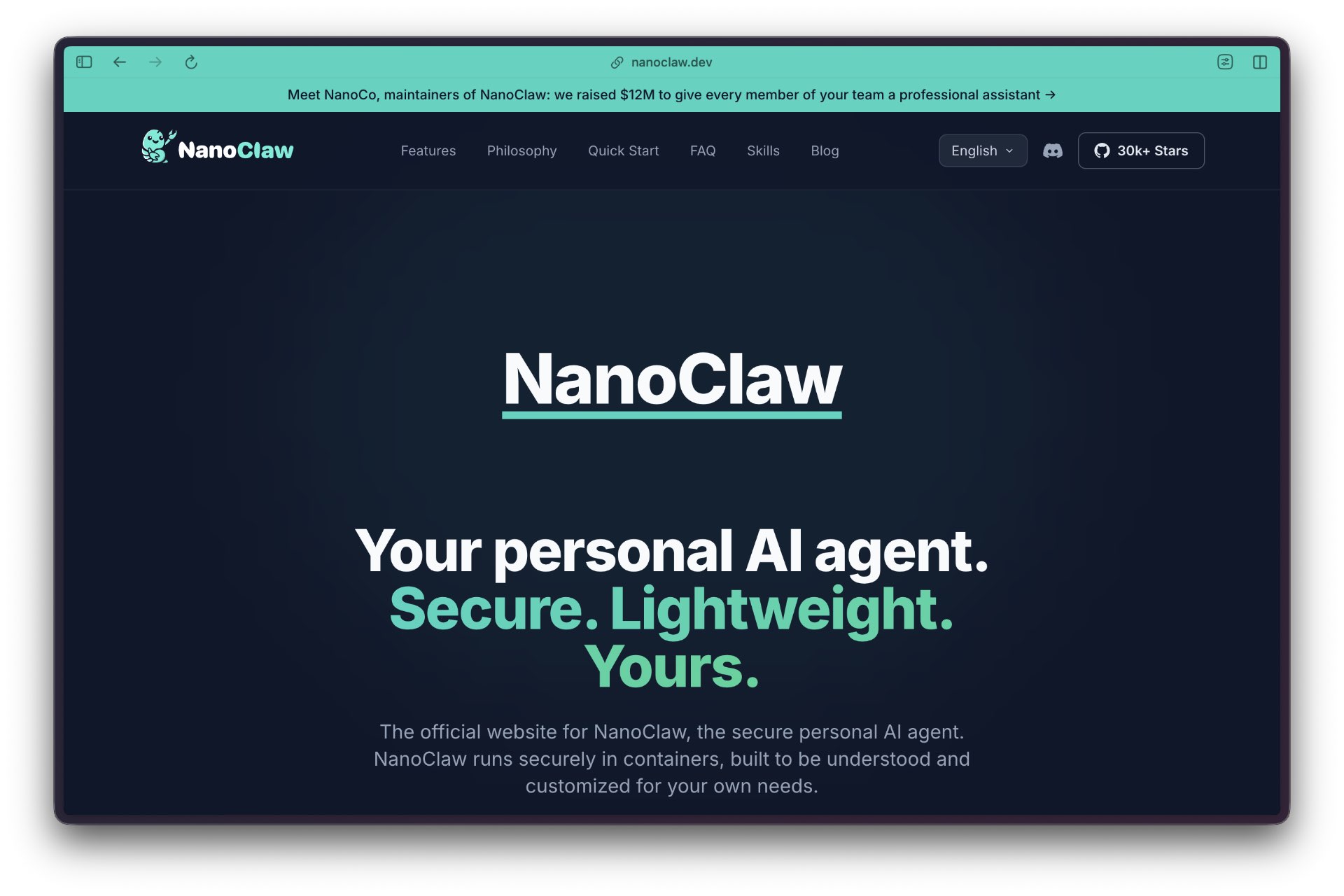
In February 2026, a weekend project by brothers Gavriel and Lazer Cohen went from a quiet GitHub commit to 20,000 stars by promising something enterprise AI giants had failed to deliver: absolute isolation.
While mainstream frameworks were collapsing under the weight of hundreds of thousands of lines of code, NanoClaw emerged as a 500-line “cage” for autonomous agents. This sudden shift represents a broader movement in the innovation landscape where security is no longer a feature, but the entire foundation.
NanoClaw is a radical rejection of the “feature-creep” that has plagued the AI agent ecosystem since late 2024. Most frameworks, like OpenClaw, have ballooned to over 400,000 lines of code, creating an impossible surface area for security audits. NanoClaw trades that complexity for a codebase that an engineer can read and fully comprehend in 20 minutes. It is the first framework to make OS-level containerization a core architectural principle rather than an afterthought.
The framework operates exclusively on Anthropic’s Claude via the Claude Agent SDK. By stripping away multi-provider abstractions and complex plugin architectures, NanoClaw achieves a state of “Time Compression” for security teams. Instead of spending weeks verifying dependencies, a lead architect can audit the entire system over a morning espresso. This simplicity is a direct response to the systemic shift toward autonomous operations, where the risk of an agent “escaping” its sandbox could mean catastrophic data loss.
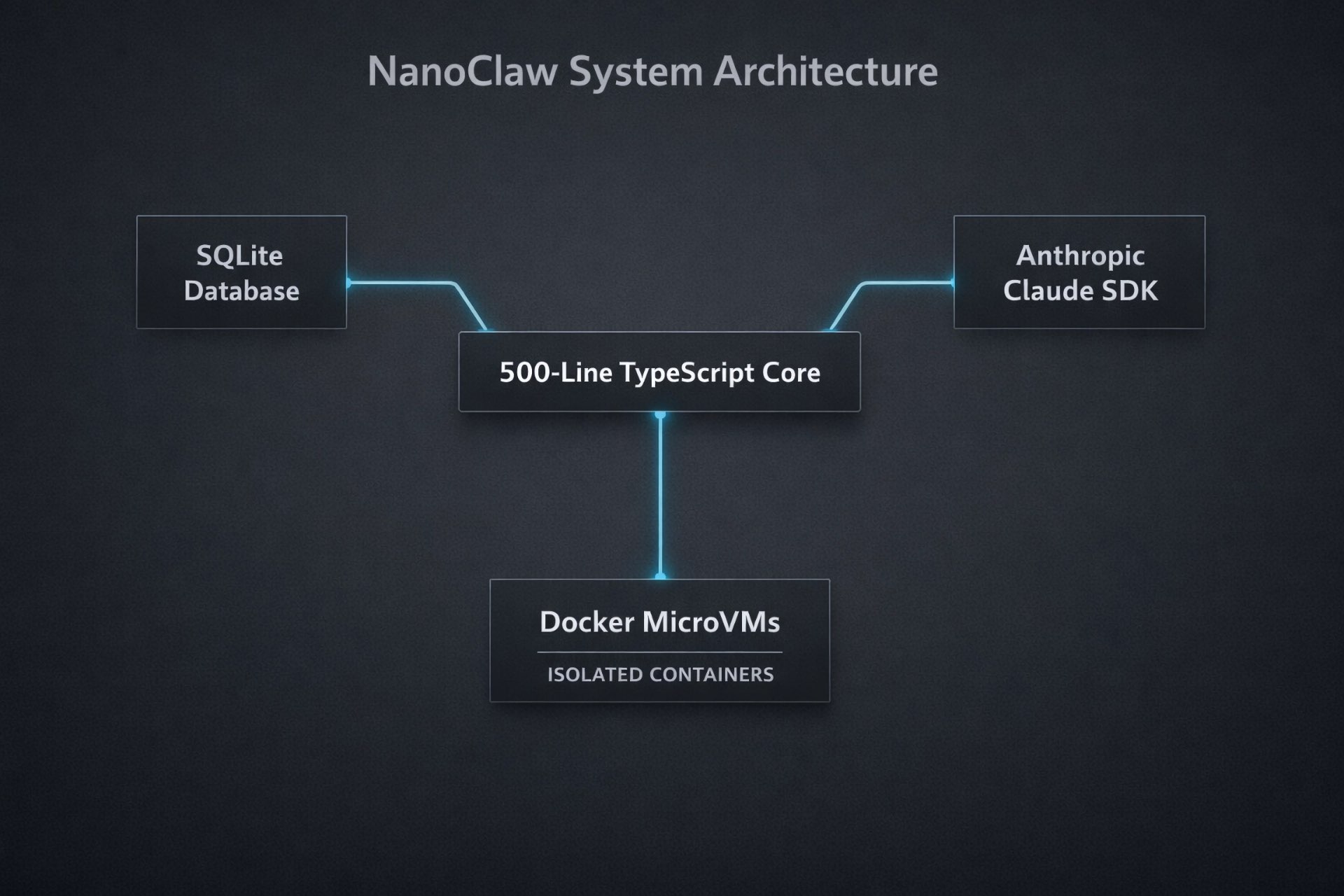
NanoClaw’s minimalist architecture: A small, auditable core managing a secure execution loop.
Architecture deep-dive
The architecture of NanoClaw centers on hardware-enforced isolation. While traditional frameworks rely on software-based permission checks: which are easily bypassed by clever prompt injection: NanoClaw uses Linux containers as the primary security boundary. On macOS, it leverages Apple Container technology, while Linux environments utilize Docker.
The system follows a linear, auditable path:
- Input channels – External sources like Telegram, Slack, or Signal feed tasks into the system.
- SQLite database – A minimalist persistent layer stores task queues and agent states, ensuring deduplication.
- Synchronous polling – A simple loop monitors for new tasks, avoiding the “hidden” behaviors of complex event-driven systems.
- MicroVM sandboxes – The recent integration of MicroVM-based Docker Sandboxes provides hardware-level isolation, ensuring agents cannot reach the host kernel.
- Claude SDK – All intelligence flows through a direct, unabstracted link to Anthropic’s API.
This “prison-cell” design philosophy ensures that even if an agent is compromised by a malicious prompt, the “blast radius” is confined to a single, ephemeral container. For the AI CEO, this level of control is non-negotiable when delegating 90% of daily operations to autonomous systems.
Operation reality
For the operator, NanoClaw feels less like a platform and more like a utility. In the current 90-50-10 Mindset: a mental model for distributing attention across three horizons of value creation where 90% is spent on AI-driven precision, 50% on structured experimentation, and 10% on radical foresight: NanoClaw sits firmly in the 90% and 50% brackets. The math is deliberately irrational because the world no longer fits inside 100%, and operators need tools that don’t add to the cognitive load.
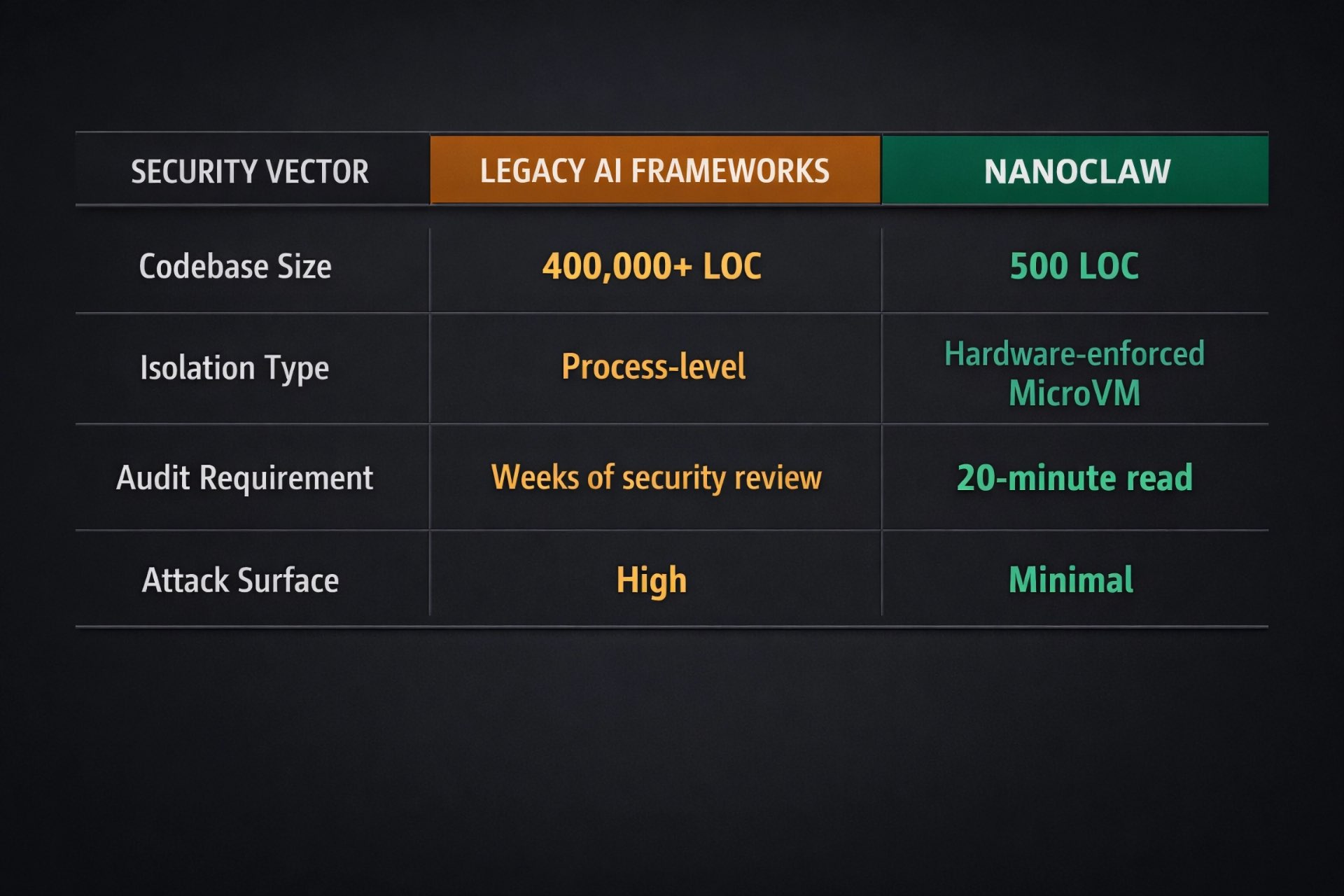
Security by Design: Every agent is trapped in its own hypervisor-level sandbox, limiting the blast radius of potential exploits.
Setting up a project is a three-step process designed for speed. First, install the package via the command line: npm install -g nanoclaw. Next, initialize the environment: nanoclaw init [project-name]. Finally, authenticate with your provider: export ANTHROPIC_API_KEY=your_key_here. Before running, operators should verify their Docker version supports the new Sandbox compatibility for maximum isolation.
Visual evidence
The following demonstrations show the framework in high-stakes environments, highlighting both the speed of deployment and the rigidity of the container boundaries.
Setup Walkthrough
A 10-minute walkthrough by Nick Ang demonstrates the initial setup via the CLI, showing how to connect a Telegram channel. The demo highlights the polling loop in action, with the terminal logging ‘task detected’ followed by the silent spin-up of a Docker container. You can see the agent autonomously browsing a repo, performing a security audit, and posting the summary back to Telegram within 45 seconds.
The AI Assistant in a Box
This demo from Docker showcases the MicroVM isolation layer, proving that even if the agent tries to ‘rm -rf’ the root directory, the host remains untouched. It validates NanoClaw’s position as a secure-by-default environment for experimental agent code.
Critical limitations
While NanoClaw excels at security, it is not a “silver bullet” for every enterprise. The radical simplification comes with significant trade-offs that an operator must weigh. Token consumption is a primary concern. Because the framework lacks sophisticated memory management, it can burn through Anthropic credits at an alarming rate. One documented case saw a user consume 7 million tokens in under an hour due to an unmonitored agent loop.
The synchronous nature of the polling mechanism also means it cannot handle real-time, high-concurrency demands. Each agent task adds a 2 to 5-second container startup overhead. For a trend-driven business requiring instant responses, NanoClaw might feel like a step backward compared to the “always-on” nature of less secure alternatives.
Strategic workflows
Despite these limitations, certain workflows are ideally suited for NanoClaw’s “sandbox” approach. These patterns capitalize on isolation rather than fight against the framework’s constraints.
- File processing pipelines – Monitoring a directory for new documents, analyzing them in isolation, and outputting results without any persistent state.
- Isolated code reviews – Allowing an agent to pull a git repository and run security audits within a container where it cannot access the internal company network.
- Automated log analysis – Watching server logs and generating alerts via a messaging channel like Discord or Slack.
- Content moderation – Processing high volumes of user-generated content for policy violations without risking the main application server.
These workflows leverage the “Time Compression” of automated agents while maintaining a hard security perimeter. This is the essence of the Ubertrends Time Compression philosophy: finding the leverage point where technology solves a problem without creating a larger one.
Final verdict
NanoClaw is a brilliant proof of concept that challenges the “more is better” philosophy of AI development. For organizations that prioritize auditability and the ability to verify every line of code, it is a superior choice to the bloated frameworks of 2024. Its partnership with Docker signals a move toward “Enterprise-grade minimalism,” where security is hardware-enforced and software-verified.
However, for teams requiring complex agent chaining or multi-model flexibility, NanoClaw will feel like a straitjacket. It is an operator’s tool, built for specific, high-security tasks rather than general-purpose AI experimentation. As the market matures, the tension between security and capability will define the next generation of agent frameworks. NanoClaw has placed its bet on security, and in an era of increasing AI-driven vulnerabilities, that bet looks increasingly prescient.
The strategic takeaway is clear: as AI agents move from curiosity to core infrastructure, the “everything is a container” approach will become the industry standard for those who value their data.
Verification Needed
- Codebase size – Confirm if the 500 lines refers only to the core logic or the entire functional repo, including dependencies (Official documentation or GitHub repo).
- Token spike incidents – Verify the specific source of the “7 million tokens in 45 minutes” claim to ensure accuracy of the metric (Community forums or case studies).
- Docker microVM compatibility – Confirm the specific Docker version required for MicroVM Sandbox support (Docker release notes or partnership announcements).